“And We have certainly made the Qur’an easy for remembrance, so is there any who will remember?” Surah al-Qamar 54:17.
The Qur’an Lives Where Ordinary Homes Keep Learning It
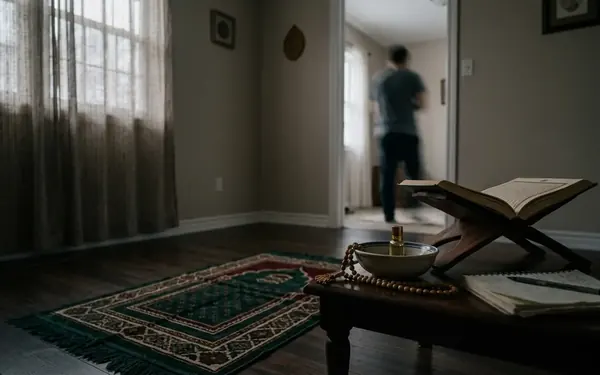
The Qur’an is carried across generations most powerfully when ordinary Muslim homes become places of recitation, understanding, obedience, and teaching. Not only libraries. Not only institutes. Not only public lectures. Homes.
A parent hearing a child’s short surah after Maghrib is not a small scene. An adult learner correcting makharij with a teacher is not late to the path. A student reading a reliable English meaning after daily recitation is not doing something secondary; that student is trying to let the words enter life.
From admiration to responsibility
Muslims rightly speak with awe about the preservation of the Qur’an. Its wording, recitation, memorization, and transmission are signs of Allah’s mercy to this Ummah. Yet admiration alone can become passive if it never reaches the prayer mat, the dining room, the child’s bedtime, or the adult’s quiet struggle with Arabic letters.
English-reading Muslims, families, students, pilgrims preparing for Hajj or Umrah, and adults who feel late in learning recitation all stand inside the same invitation: remember, receive, and pass on.
Field Note: The most durable Qur’an routine is often modest. It has a time, a voice, a teacher when needed, and a next act of obedience.
A Trust Received, Not a Culture Inherited
The Qur’an is not merely a marker of Muslim identity, family custom, or community memory. It is divine guidance, and guidance must be consciously received.
A home may have printed mushafs on a high shelf, Qur’an apps on several phones, and translations in English, yet no fixed recitation time during the week. That contrast should make us pause. Possession is not the same as companionship.
The chain has many hands
Parents set the household rhythm. Teachers correct recitation. Elders model reverence. Imams protect communal standards. Students carry lessons forward. In the Sunni Hanafi-Deobandi educational framing, learning is not casual religious inspiration; it is adab, talaqqi, correction, repetition, and practice.
That chain is tender as well as disciplined. A grandmother who listens carefully, a father who learns beside his child, a mother who keeps roughly the same ten minutes after Isha, a teacher who corrects without humiliating: all of these are part of how the trust moves.
What can be lost while everything looks present
A family with several mushafs, Qur’an apps, and framed verses can still fail the generational trust if nobody recites aloud, learns meanings, corrects mistakes, or changes conduct.
I find it helpful to ask a sharper question than “Do we own the Qur’an?” The better question is: “Where does the Qur’an interrupt our week?”
Recitation Is the Doorway, Not a Decorative Skill
Correct recitation matters because the Qur’an is heard, memorized, prayed, and transmitted through the tongue before it becomes a subject of discussion. The sound is not decoration. It is part of the discipline of receiving Allah’s words with care.
A small pathway for embarrassed learners
Many adults delay because they feel exposed. Children sometimes rush because they want to finish. Converts may struggle with Arabic letters that have no English equivalent. Busy professionals tell themselves they will begin when life becomes quieter, and life rarely agrees.
Start with about 8 to 12 minutes daily, ideally at the same time, for around 6 consecutive days. Recite aloud. Listen to a careful reciter for the same passage. Repeat the passage twice. Mark one word needing correction. Then review with a teacher or a stronger reciter.
Ask for one or two recurring mistakes at a time: confusing ح and ه, stretching vowels inconsistently, or stopping in the wrong place because breath runs out. A learner who tries to fix everything at once usually fixes very little.
Important: Transliteration can help as a temporary bridge, but it should not become the permanent tool. An adult who relies on it for too long may memorize sounds that are difficult to correct later.
When self-study is not enough
Short clips can remind. Apps can support. A printed guide can help the eye. But when a qualified teacher or reliable recitation circle is available, isolated self-study should not carry the whole burden. The Qur’an has always moved through listening, correction, and repetition.
Understanding Protects Recitation from Becoming Habit Alone
Recitation opens the heart to Allah’s commands, promises, warnings, stories, and signs. If the tongue moves but the heart never asks what Allah is calling it toward, the routine has thinned.
English meanings are a mercy for readers who are still growing in Arabic. They allow a family to notice a command, a warning, a mercy, a story of the Prophets, or a description of the Hereafter. Still, an English translation is an aid to meaning; it is not the Arabic Qur’an itself in recitation, prayer, or scholarly interpretation.
A prayer-based self-check
Choose one verse or short surah already recited in salah. Then ask: has this passage changed speech, spending, modesty, patience, or family conduct during the last week?
That question is uncomfortable in a useful way. It moves the learner from “I know this surah” to “This surah is teaching me.”
Reflection has boundaries
Individual reflection is encouraged. Legal rulings, creed, the attributes of Allah, inheritance, divorce, jihad, ambiguous verses, and complex passages require recognized scholarship and disciplined tafsir. This is a learning pathway for devotional households, not a method for issuing rulings from translations.
A simple household format works well after recitation: read the English meaning, identify one command or warning, and name one behavior to adjust before the next prayer.
The Proof of Learning Is Obedience
Qur’anic learning is incomplete when it stops at pronunciation or information. It must become salah, honesty, mercy, repentance, and restraint.
The test may arrive in a sale where dishonesty would bring money. In a family argument, it may arrive when lowering the temperature feels harder than winning. Online, it may arrive where humiliating speech is easy and applause is quick. Before the day ends, it may arrive when calling parents is more important than another scroll through the phone.
Where the verse meets the day
Preparation for Hajj and Umrah belongs here too. Qur’anic consciousness before travel is not only about learning the rites. It includes repentance, lawful spending, patience in crowds, and guarding the tongue before entering sacred places.
There is mercy in this standard. A person who missed Fajr, lost patience at work, or spoke harshly at home is still addressed through tawbah, renewed salah, and the next act of obedience. The Qur’an does not call people to despair; it calls them back.
Teaching does not mean every Muslim becomes a formal scholar. It means every learner preserves one link according to capacity, while scholars and teachers remain the guides for advanced knowledge.
Different learners need different doors
A child needs rhythm and affection. A parent may help a child repeat a short surah for close to 5 to 7 minutes after Maghrib, ending with warmth rather than scolding over every slip.
A teenager needs meaning and relevance. Connect a verse to phone use, friendship, speech, modesty, prayer, or honesty. Abstract warnings alone often float above the real battlefield.
An adult needs consistency. A fixed recitation slot after Fajr or Isha for 10 minutes on weekdays, with a longer review once a week with a teacher or circle, is more useful than an intense plan that disappears after three days.
A pilgrim needs Qur’anic consciousness before travel: repentance, patience in crowds, lawful spending, and a tongue trained away from complaint.
Learning across languages and communities
Many Muslim families now learn across languages, countries, and levels of prior knowledge. Multilingual Islamic education serves this reality when it keeps scholarship accessible without flattening the discipline. Mohammad Najeeb Qasmi is part of a wider scholarly effort serving readers who seek accessible Sunni Hanafi-Deobandi guidance in community settings.
A household with small children may need a 5 to 7 minute affectionate routine, while adult learners may benefit from 10 to 12 minutes of focused correction and weekly review. The form changes. The trust remains.
Begin With One Page, One Meaning, and One Act
Do not begin with a plan so large that it needs a perfect week. Begin with one fixed appointment.
A household practice for this week
Choose one fixed household time between Maghrib and Isha or immediately after Fajr.
Keep the gathering to 12 to 18 minutes.
Recite one page or one short surah.
Read a reliable English meaning.
Identify one command or character lesson.
Decide one action for the next day.
For someone living alone, the same practice can happen after Fajr or Isha. Write one sentence in a notebook beginning with: “Tomorrow I will practice this by…”
Before you sleep tonight, place the mushaf where Fajr will be prayed and decide the first passage you will recite tomorrow.