Core Passage: Prayer as Remembrance, Restraint, and Return
A worshipper who treats Salah only as bodily performance preserves an outward habit while missing the heart’s nearness to Allah. Neglecting the legal form, on the other hand, loses the ordered discipline through which devotion is protected. The stakes of daily prayer require holding both realities together.
The Qur’an anchors this balance in Surah Al-‘Ankabut (29:45): “Indeed, prayer restrains from shameful and unjust deeds, and the remembrance of Allah is greater.” This verse joins inward remembrance directly with outward moral effect. It does not separate the spiritual feeling of worship from the ethical conduct that must follow it.
Educational guidance associated with Dr. Mohammad Najeeb Qasmi since 2010 has emphasized a clear pattern: the preservation of prayer requires both outward discipline and inward presence. This approach invites worshippers to recover the inner purpose of Salah without weakening its legal requirements. Regular worshippers may still experience haste, wandering thoughts, or a visible gap between prayer and conduct after the final salam.
The Legal Form Is Not an Empty Shell
The legal form of Salah—purification, facing the qiblah, standing, recitation, bowing, prostration, and order, guards worship from becoming vague emotion or private invention. Fiqh operates as mercy and structure. It teaches the worshipper how to stand before Allah with discipline, not merely how to complete a checklist.
A sermon that praises inner spirituality while barely mentioning purification, qiblah, recitation, ruku‘, sujud, and order would sound devotional but would undermine the very form through which Salah is preserved. The operational sequence defines the boundaries of the act. However, we must differentiate legal validity from spiritual fullness.
A worshipper may say the opening takbir correctly while the mind remains with a work dispute, a shop account, a family argument, or an unpaid bill. The prayer counts legally, yet it remains spiritually hollow. While this framework provides devotional instruction, questions regarding an individual prayer’s validity, missed prayers, or school-specific rulings require consultation with a qualified scholar who can hear the details.
Khushu‘: The Heart Learning to Stand Still
Khushu‘ manifests as humility, attentiveness, reverence, and inward stillness before Allah. It is not a mystical feeling that must be forced. Instead, it is the conscious decision to return attention to the Creator whenever the mind wanders.
Connecting khushu‘ to the opening takbir requires preparation. Saying “Allahu Akbar” should reduce the imagined importance of everything competing with the prayer. A practical pre-takbir practice involves pausing for roughly 10-20 seconds before raising the hands. Settle the body. Consciously leave unfinished concerns outside the prayer space.
Common obstacles routinely break this focus. Rushing, praying at the edge of time, unresolved anger, over-familiarity with recitation, and performing movements automatically all degrade presence. Distraction controls are essential. Place the phone outside arm’s reach before takbir, and do not check it during the around 60-90 seconds immediately after salam.
To build focus, choose one phrase per prayer, such as Alhamdu lillahi Rabbil ‘alamin, Subhana Rabbiyal ‘Azim, or Subhana Rabbiyal A‘la. Understand it consciously during that specific Salah.
Bottom Line: Valid form protects the prayer; khushu‘ awakens the worshipper inside that form.
What the Postures Teach the Soul
The major postures of Salah offer spiritual lessons rather than only legal movements. Moving through them with awareness turns routine into revelation.
During the standing posture (qiyam), the servant presents the self before Allah. The worshipper begins upright, hands placed according to juristic practice, listening to the Qur’an rather than centering personal speech. The ego is quieted.
Recitation follows. Surat al-Fatihah becomes a covenant of praise, dependence, guidance, and accountability in a short, repeated recitation. It is a direct conversation between the servant and the Lord.
The body then lowers from upright control into bowing (ruku‘). This physical descent trains the servant to confess Allah’s greatness and reduce personal pride.
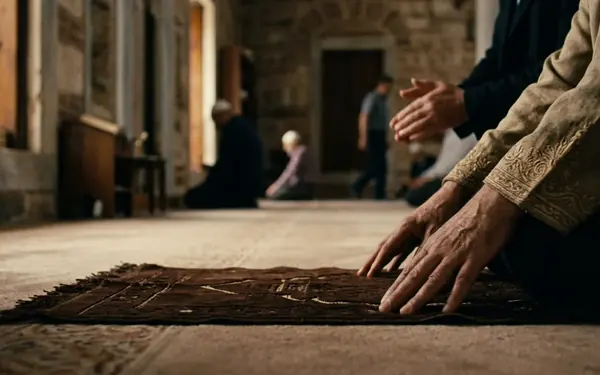
Prostration (sujud) brings the forehead, nose, hands, knees, and feet to the ground. It is the posture most visibly opposed to arrogance, placing the highest part of the body in the dust.
Finally, the sitting between prostrations is not an empty transition. The pause is a moment of profound need, where the worshipper silently asks for forgiveness, mercy, guidance, and provision.
When Salah Leaves the Prayer Mat
Returning to Qur’an 29:45, Salah is explicitly meant to restrain indecency, injustice, arrogance, dishonesty, and heedlessness. The inner purpose of Salah faces its true test immediately after the salam.
The first about 5-15 minutes after prayer serve as a practical testing ground. This window dictates speech with family, honesty in trade, restraint in anger, modesty online, and compassion toward the weak. If Fajr is prayed and the tongue wounds a spouse, child, parent, or colleague by breakfast, the next step is repentance and repair, not self-congratulation for having prayed.
Prayer acts as a repeated divine appointment that gradually disciplines the conscience when performed sincerely. It does not guarantee immediate perfection, but it demands continuous effort.
Field Note: After each prayer, choose one small moral action such as returning a right, softening a word, avoiding doubtful income, or asking forgiveness from someone harmed.
How to Repair a Prayer That Feels Dry
Many regular worshippers feel their Salah has become repetitive, emotionally distant, or spiritually weak. Spiritual dryness should lead to renewal, not abandonment. The servant remains at the door even when sweetness is not felt.
From group experience, a small consistent act of attention kept for 7-10 days is often more reliable for building focus than an intense resolution that disappears after two days. Begin with a practical renewal routine. Make wudu with deliberate intention. Praying at the earliest reasonable time creates a helpful condition for presence, removing the anxiety of a closing window.
Remove the phone from reach. Learn the meaning of one repeated phrase. Make a short du‘a after salam.
When guiding children, adjust the vocabulary. Replace the command to simply "finish your prayer" with an invitation to "stand before Allah with respect." This shifts the focus from task completion to divine encounter.
Important: A sermon that only lists legal components may leave a regular worshipper able to complete the prayer correctly while still praying in haste, checking the phone immediately after salam, and speaking harshly moments later.
A Prayer That Changes the Next Moment
A father returns to a small apartment after a long shift at work, his patience worn thin. He hears the adhan from his phone, places the device face down on the counter, and walks to the sink to make wudu. He spreads his mat and stands for Maghrib while his young child watches quietly from the doorway.
He slows his recitation of Al-Fatihah. He bows with deliberate awareness. He lowers himself into sujud, offering a private, silent repentance for the harsh words he spoke to a colleague earlier in the afternoon. After the final salam, before resuming his meal, checking messages, or starting household tasks, he turns and calls his child close to apologize for being dismissive that morning. The prayer mat is folded, but the servant carries the sujud into the room.