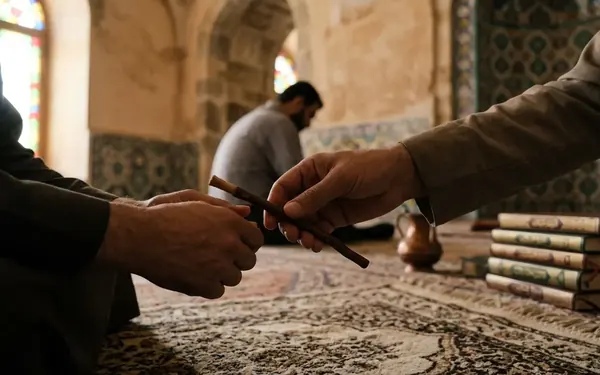
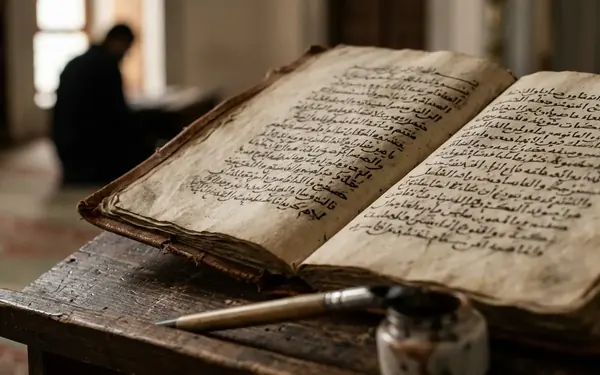
After Fajr, before the house begins to stir, a worshipper stays seated on the prayer mat for a few quiet minutes. A marked Qur’an page rests open beside a small notebook. On the page are verses about Allah’s oneness; in the notebook are three handwritten headings: belief, speech, and practice.
The question is not dramatic. It is the kind many careful Muslims carry silently: did that phrase I heard, that habit I inherited, or that thought I never examined cross the boundary of Tawhid?
This article begins there, in private hesitation rather than public accusation. The aim is not to make Muslims suspicious of one another. It is to offer a careful Sunni framework for recognizing Shirk in belief, speech, and practice today.
We define Tawhid first because error is measured against truth, not against fear. Tawhid is the foundation of Islamic faith: Allah alone is Lord, Allah alone deserves worship, and Allah alone possesses the qualities of divinity without limit or partner. Shirk is the direct contradiction of that foundation, whether it appears in creed, words, or acts of devotion.
Tawhid as the Measure: What Surah Al-Ikhlas Teaches
Surah Al-Ikhlas is short enough for many Muslims to recite from childhood, yet it gives a remarkably complete measure for belief. It is Surah 112 in the common mushaf order and consists of 4 verses. Its language is brief, but it leaves little room for confusion about who Allah is.
The Surah teaches that Allah is One, Eternal, Besought by all, neither begetting nor begotten, and without equal. That last boundary matters. No prophet, angel, saint, scholar, parent, ruler, or spiritual cause resembles Allah in His divinity.
Why Al-Samad matters
The name Al-Samad points to Allah’s absolute self-sufficiency and to the reality that all creation turns to Him in need. Creation is honored, but never independent. Creation may serve, teach, carry, intercede by permission, or become a means of help, yet every created being remains dependent and limited.
A known report mentions an Imam at Quba who repeatedly recited Surah Al-Ikhlas in prayer because he loved its description of Allah. That affection is not merely emotional; it is theological training. The believer keeps returning to the description of Allah so the heart does not exaggerate the status of anything else.
Scholars discuss whether the Surah’s period of revelation was Makkah or Madinah. That discussion has its place, but it is not the main burden here. Prophet Muhammad (PBUH) received this revelation, and the Surah continues to serve Muslims as a concise guardrail for Tawhid.
Shirk in Belief: Where the Heart Assigns Divine Qualities
Shirk in belief occurs when the heart assigns Allah’s exclusive qualities to a created being. Three tests are especially useful: absolute knowledge of the unseen, ultimate control over benefit and harm, and independent power to create or decree outcomes.
This distinction protects both reverence and creed. Muslims honor the prophets, love the righteous, respect scholars, and recognize the roles of angels. But respect is not divinity. Love is not worship. Rank is not independent authority.
Consider familiar examples from basic Islamic knowledge. Jibrail delivers revelation by Allah’s command. Izrail takes souls by Allah’s command. Munkar and Nakir question the dead by Allah’s command. Their roles are real, but their power is not separate from Allah’s will.
The same principle helps when discussing saints, teachers, spiritual guides, or elders. A righteous person may be a means of guidance. A teacher may open a door of understanding. A parent’s du‘a may comfort the heart. The boundary is crossed when the created means is treated as having divine knowledge, divine control, or independent power.
Bottom Line: Honoring the righteous is not Shirk. Giving any created being Allah’s exclusive attributes is the danger. The safest habit is to keep means in their place and return every benefit, protection, and decree to Allah.
Shirk in Speech: Phrases That Need Correction
Speech matters because repeated phrases train the heart. A person may speak casually and mean nothing theological, but careless wording can normalize weak belief over time.
Here the educational approach must be careful. Correcting a phrase is not the same as declaring the speaker outside Islam. Intention, knowledge, wording, and scholarly assessment matter before any personal ruling is made. This article is a learning guide, not a fatwa on named individuals.
Sort the meaning before reacting
Some expressions are clearly wrong because they give divine control to other than Allah. Others are careless exaggerations. Some are acceptable if the speaker means ordinary cause and effect, not independent power. The useful question is: what does the phrase imply?
Provision: Avoid wording that makes a person sound like the independent giver of rizq. Say, “Allah helped me through this person.”
Fate: Avoid speaking as if a created being controls destiny. Use “by Allah’s permission” when describing help, rescue, or opportunity.
Unseen knowledge: Do not claim independent access to the unseen for anyone. When discussing what is hidden, say, “Allah knows best.”
Protection: Means of protection are lawful when kept as means. The heart should not treat them as self-powered shields.
Exaggerated praise: Love and gratitude are good, but praise should not give a created person qualities that belong only to Allah.
The Azan quietly retrains this discipline every day. Its repeated declaration of Allah’s greatness and its testimony of faith place the tongue back in order: Allah is greater than every fear, every dependency, and every admired human being.
Important: Do not turn phrase correction into a habit of judging people. Teach the better wording, ask what was meant when needed, and leave serious rulings to qualified scholarship.
Shirk in Practice: Worship, Ritual, and Reliance
Shirk in practice is directing acts of worship to other than Allah. The most obvious examples are du‘a, sacrifice, vows, and ultimate reliance. These are not ordinary social gestures; they carry worship meaning.
Du‘a belongs to Allah. Sacrifice offered as worship belongs to Allah. A vow made in devotional surrender belongs to Allah. Ultimate reliance, where the heart rests as though a created being independently controls the outcome, belongs to Allah alone.
Practice is not judged by appearance alone
A cultural action is not assessed by outward shape alone. The relevant question is whether it carries worshipful devotion, divine attribution, or merely ordinary respect and custom. Standing for an elder, visiting family graves, giving charity on behalf of the deceased, or receiving advice from a scholar cannot be flattened into one category without examining meaning, intention, and the act itself.
Lawful routines and Sunnah practices can strengthen Tawhid when performed for Allah. Fasting with Sahri and Iftar is not empty habit when the believer intends obedience. Ramadan fasting is commonly dated to 2 AH, linking the practice to revelation and the early Madinan period rather than custom alone.
The same applies to emphasized Sunnah practice, including Sunnat-e-Muakkada prayers. They train the body to return to Allah in repeated devotion. They do not compete with Tawhid; they embody it when performed sincerely.
Field Note: When assessing a practice, I find it helpful to ask a plain question before using heavy labels: is this person treating a created thing as a means, or as an object of worship?
Khatm-e-Nabuwat and the Boundary of Islamic Belief
Khatm-e-Nabuwat is the doctrine that Prophet Muhammad (PBUH) is the final prophet. It is linked to the Qur’anic title Khatam-an-Nabiyyin in Surah Al-Ahzab 33:40.
The verse comes in a context that includes Mutabanna, the pre-Islamic practice of treating an adopted son as a biological son for lineage rulings. The Qur’an corrects that lineage confusion and, in the same verse, names Prophet Muhammad (PBUH) as the Messenger of Allah and Khatam-an-Nabiyyin. Mainstream Sunni scholarship has understood the verse as addressing lineage while also establishing the finality of prophethood.
This is why later prophetic claims are not treated as a small disagreement within ordinary theology. They touch a boundary of Islamic belief. Within mainstream Sunni scholarship, the finality of prophethood has been treated as a settled doctrine across approximately 1400 years of Islamic consensus.
That doctrinal boundary should be taught with clarity, not anger. The point is not to turn every conversation into a slogan. The point is to keep the community’s creed anchored in the Qur’an, the Sunnah, and the recognized inheritance of Muslim scholarship.
A Careful Self-Audit for Daily Faith
Self-examination is healthier than accusation. A Muslim can review belief, speech, and practice without becoming harsh toward family, neighbors, or the wider community.
Use these three questions in order:
What do I believe about Allah’s exclusive qualities?
What do my common phrases imply?
What acts do I treat as worship?
The order matters. Begin with the heart, then listen to the tongue, then examine outward devotion. A person who starts with argument usually becomes skilled at finding other people’s faults. A person who starts with Tawhid becomes more careful, and often more gentle.
Learning should move through Qur’an, Hadith, Tafseer, and qualified scholarship. Material by Mohammad Najeeb Qasmi on belief and devotional practice reflects this community need: readers often want plain religious language without losing scholarly grounding. That is a good instinct to preserve.
At sunset, the family gathers for Iftar. A child praises a neighbor with an exaggerated sentence, trying to express gratitude for a bag of dates left at the door. The father smiles, lowers his voice, and says, “Say it this way: Allah helped us through them.” Then the dates are passed around, hands are raised for du‘a, and the lesson settles without turning the table into a courtroom.