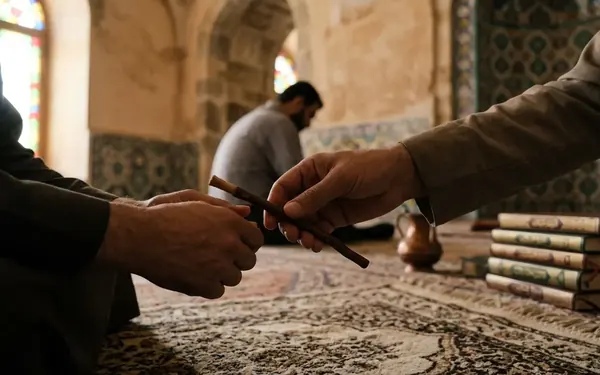
“A Mercy to the Worlds”: The Qur’anic Frame
“We have sent you only as a mercy to the worlds” — Qur’an 21:107.
The study should begin here: not with a mood, not with a slogan, but with a Qur’anic description of the mission of Prophet Muhammad (PBUH).
Mercy in the Seerah is not a decorative virtue added to a life of leadership. It is part of the frame through which that life is read. When the Qur’an names him as mercy, the reader is invited to look again at worship, family life, disagreement, and public conduct. The question becomes more demanding than “Was he kind?” It becomes: how did revelation teach a whole community to recognize mercy without losing truth?
Field Note: This guide is selective. It follows selected Qur’anic and well-known Seerah examples; it does not attempt to cover the full Makkan and Madinan biography from 610–632 CE.
Reading Seerah as moral training
I find this shift important because many readers approach Seerah as a sequence of events: birth, calling, opposition, migration, battles, treaties, farewell. That sequence matters. Still, devotional study asks another layer of questions. What does this event train in me? What kind of speech does it correct? What impatience does it expose?
When read this way, the Seerah becomes a mirror held gently but firmly before the heart.
Mercy is then not reduced to softness of personality. It becomes obedience to Allah expressed through restraint, concern, patience, and wise correction. Sometimes it comforts. Sometimes it calls a person back from sin. Sometimes it waits until the right moment to speak.
Mercy Before Power: The Prophetic Response to Harm
The Makkan period matters because it shows mercy under pressure. For about 13 years before the Hijrah to Madinah, the Prophet Muhammad (PBUH) called people to tawhid while enduring insult, rejection, and social pressure. Mercy was not displayed after comfort had arrived. It appeared while the believers were vulnerable.
That changes how we read restraint.
Ta’if without embellishment
The well-known episode of Ta’if is often remembered as one of deep rejection after severe pressure in Makkah and before the Hijrah. The established meaning is enough: the Prophet (PBUH) did not seek the destruction of those who had rejected and harmed him. He remained attached to Allah’s guidance for people rather than to revenge against them.
There is no need to add invented dialogue or dramatic detail. The moral weight is already clear.
Bottom Line: Prophetic mercy begins when the believer has the ability to retaliate but chooses restraint for Allah’s sake.
Restraint is not surrender
A common mistake is to imagine mercy as passivity. The Seerah does not support that reading. The Prophet (PBUH) continued calling to truth. He did not rename shirk as harmless, nor did he abandon the message so that people would feel undisturbed.
His mercy was principled. It refused revenge, but it did not refuse revelation.
This distinction helps in ordinary conflict. In a family argument, mercy may mean not using an old wound as a weapon. At work, it may mean answering hostility without copying its tone. In a mosque or community disagreement, it may mean slowing the conversation before suspicion becomes the loudest voice in the room.
Important: If mercy becomes mere agreeableness, it loses its Prophetic shape. The Seerah joins restraint to obedience, patience to truth, and gentleness to accountability before Allah.
Mercy at Home: Gentleness in Ordinary Moments
Public patience is visible. Domestic patience is repeated.
That is why mercy at home deserves careful attention. The home is where tone of voice, timing of correction, facial expression, and patience during repeated requests reveal what has actually settled in the heart. It is possible to speak beautifully in a study circle and harshly in the kitchen. The Seerah does not allow that split to feel comfortable.
Small moments carry spiritual weight
The Prophet Muhammad (PBUH) showed kindness toward children, tenderness with family, and a habit of easing burdens rather than magnifying them. These reports are not ornamental stories for children’s books. They teach adults how religious seriousness should sound when no audience is present.
Sahih al-Bukhari and Sahih Muslim report the meaning that Allah loves gentleness in all matters. That phrase belongs beside the most ordinary scenes: a child asking again, a spouse speaking at the wrong time, an elder repeating a concern, a guest misunderstanding a custom.
Gentleness is not the absence of correction. It is correction held in the discipline of mercy.
A pause before correction
Before correcting someone at home, pause long enough to ask a harder question: will this bring the person nearer to Allah, or will it merely release my irritation?
That pause can change everything. It may delay the correction until anger cools. It may shorten the lecture into one clear sentence. It may change the face before it changes the words. In devotional practice, these small adjustments are not cosmetic; they are part of adab.
- Lower the voice before choosing the words.
- Correct at a time when the person can actually hear.
- Separate the mistake from the person’s dignity.
- Do not make repeated requests an excuse for contempt.
Field Note: Mercy at home is often quieter than people expect. It may be a cup moved without complaint, a correction postponed, or a tired parent refusing to turn exhaustion into sharpness.
Mercy Without Excusing Sin
Prophetic mercy opens a door to repentance, but it does not rename disobedience as harmless.
This balance is easy to disturb. One error is harshness that drives people away from religion. Another is softness that treats Allah’s commands as optional. Neither reflects the disciplined mercy found in the Prophet’s guidance.
The ashamed, the confused, and the burdened
People came to the Prophet (PBUH) in different states: ashamed, confused, burdened by sin, or unsure how to return. The guidance they received was not humiliation. It was wisdom. It directed them toward tawbah, lawful conduct, and hope in Allah’s mercy.
This is the difference between exposing a person and guiding a person. Exposure may satisfy the ego of the corrector. Guidance seeks the servant’s return to Allah.
A teacher, parent, or friend can hold moral clarity without speaking as if the sinner is beyond repair. The Qur’an and Sunnah do not train believers to be casual about sin, but neither do they train them to crush the one who is trying to stand up again.
When compassion needs clarity
There are moments when mercy requires a clear “no.” A harmful habit, a forbidden transaction, a broken duty, or a pattern of injustice cannot be softened into acceptability. But the way that “no” is delivered matters.
Disciplined mercy speaks with adab. It distinguishes between the ruling and the person’s worth. It leaves room for tawbah. It remembers that guidance belongs to Allah, while the believer is responsible for truthful and careful speech.

Important: Devotional advice should not be treated as a binding legal answer for complex personal matters, especially questions of worship, family, inheritance, finance, or marital conflict. Such cases should be taken to qualified scholars who can hear the details properly.
A Community Shaped by Prophetic Mercy
Mercy does not remain private. If it is real, it appears at the mosque entrance, in the study circle, at a family gathering, during Hajj or Umrah preparation, and inside an online message thread written late at night.
Communal mercy is not vague niceness. It has habits.
Teaching with concern for the learner
Religious teaching should carry clarity, patience, accuracy, and concern for the learner’s capacity. Remove any one of these, and something bends out of shape. Clarity without patience can become severe. Patience without accuracy can become careless. Accuracy without concern for capacity can overwhelm a sincere beginner.
This is where community education needs a Prophetic measure. The aim is not to display how much the teacher knows. The aim is to help the learner take the next truthful step toward Allah.
In the ongoing educational work associated with Mohammad Najeeb Qasmi, this matters especially because readers arrive with different languages, backgrounds, and levels of preparation. Guidance on Hajj, Umrah, Qur’an, Hadith, Islamic jurisprudence, history, and Deobandi scholarship should make sacred knowledge more reachable while remaining anchored in recognized sources.
What mercy looks like in shared spaces
At the mosque entrance, mercy may mean welcoming a new worshipper who is unsure where to stand. In a Hajj or Umrah preparation setting, it may mean assisting a pilgrim who is confused about a ritual step instead of embarrassing him. In an online discussion, it may mean slowing down speech during disagreement and refusing to turn correction into performance.
- Welcome before testing someone’s background.
- Explain a ruling clearly without turning the learner into an example.
- Make space for sincere questions.
- Keep disagreement tied to evidence, not suspicion.
- Protect the dignity of beginners, elders, and returning worshippers.
Bottom Line: A merciful community does not become careless with knowledge. It becomes more careful with people while staying faithful to Qur’an, Hadith, jurisprudence, and reliable scholarship.
A Prayer for a Merciful Heart
O Allah, place Prophetic mercy in our speech, so our words do not wound where they should heal. Place mercy in our judgments, so we do not confuse firmness with pride. Place mercy in our homes, where our character is known without decoration. Place mercy in our private thoughts, where only You see what we excuse, repeat, and conceal.
Make us truthful without cruelty, gentle without weakness, and hopeful without forgetting accountability.
A practice before the next prayer
Name one person who needs your gentleness today.
Do not choose a general category. Choose a person: a child, a parent, a spouse, a student, a colleague, a worshipper you find difficult, or someone whose message you have been delaying. Then decide one merciful action before the next prayer. A softer reply. A delayed correction. A sincere apology. A practical help offered without making the person feel small.
The practice is simple enough to begin now and serious enough to expose the heart.
After ‘Isha, a father stands at the doorway and sees his tired child dragging a school bag across the floor. The sharp sentence rises first; he can feel it ready on his tongue. Then he remembers mercy as training, not decoration, and chooses a softer voice: “Come, let us put it away together.”