From Prophetic Speech to Verified Transmission
The preservation of Hadith began directly with the Prophet’s ﷺ speech. He possessed Jawami' al-Kalim, the unique gift of conveying expansive meanings in concise words. This eloquence was shaped within the Arabic environment of Quraish and his early upbringing among Bani Sad.
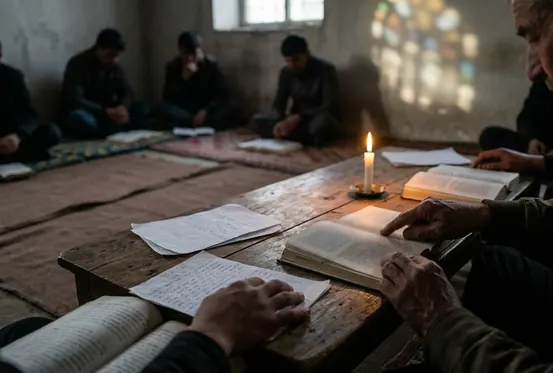
The Companions recognized the weight of his speech and preserved both wording and meaning with intense seriousness.
Bara ibne Aazib serves as a clear example of strict word-for-word adherence in transmission. This individual discipline later grew into a formal collection movement. In the standard historical account, official state-sponsored collection began during the reign of Umar bin Abdul Aziz, around 99–101 AH. The broader formal writing of Hadith then developed steadily through the 2nd Century Hijri.
Imam Bukhari and the Making of a Hadith Masterpiece
Mohammed bin Ismail, widely known as Imam Bukhari, authored Sahih Al-Bukhari. His father, Ismail, preceded him in this scholarly path, establishing a foundation of learning early in his life.
Tradition reports that Imam Bukhari used Istikhara before recording each Hadith. This practice stands as a devotional feature of his scholarly discipline rather than a statistical proof of authenticity.
Why Sahih Al-Bukhari Became Central in Sunni Study
New students must first grasp the terminology of verification. Sahih designates an authentic or strong category of Hadith. Sahih Al-Bukhari holds a central position within the Sihah Sittah, the six most authentic Hadith books in Sunni scholarly usage.
When a narration is recorded in both Sahih Al-Bukhari and Sahih Muslim, it is classified as Muttafaq Alayh, or Muttafaq Alaih. This dual recording helps students understand why certain narrations receive special attention in teaching circles.
The text requires guidance. The extensive work of major commentators like Allama Ibn Hajar Asqalani demonstrates that Sahih Al-Bukhari is traditionally studied through expert explanation.
The Book’s Structure: Chapters, Headings, and Hidden Fiqh
The physical layout of the text serves as a teaching tool. Tarjumatul Alabwab refers to the chapter headings of Sahih Al-Bukhari. Imam Bukhari often indicates his legal reasoning directly through these headings.
Beginners should not treat the book as a simple list of narrations. Its arrangement actively teaches creed, worship, ethics, law, and spiritual discipline.
Students will encounter Muallaqaath, which are narrations with one or more missing links in the chain. A common mistake occurs when a student treats every Muallaq narration as if it has the same function as a fully connected narration in the main chain. Readers must rely on qualified commentary to understand their placement. The text also contains Thulathiyat, or Sulaasiaat—narrations with only three intermediaries between Imam Bukhari and the Prophet ﷺ.
Sanad, Authenticity, and the Caution New Students Need
Verification relies entirely on the Sanad, the chain of narrators reaching the source. While classical methodologies prioritize continuous chains, scholars evaluate transmission strength through precise categories.
Tawatur indicates continuous narration by a large group, providing strong certainty in transmission. Mashur describes a Hadith narrated by a large group or one that has become widely transmitted among scholars. Conversely, Dha’eef means weak, and Maudu or Mau’dhu means fabricated.
Important: Weak or fabricated reports should not be quoted casually, especially in sermons, family messages, or social media captions.
This beginner’s rule against casual quoting does not replace the detailed juristic discussions on using some weak narrations in virtues of deeds. Scholars maintain specific frameworks for this when the subject is already established by stronger evidence.
Reading Bukhari Alongside Muslim, Nawawi, and Later Commentaries
Students rarely encounter Sahih Al-Bukhari in isolation. It is frequently studied alongside Sahih Muslim because narrations found in both are called Muttafaq Alayh.
Imam Muslim bin al-Hajjaj authored this companion text. Historical records place his birth in either 202 AH or 204 AH, and his death in 261 AH. The Muqaddama of Sahih Muslim serves as a critical introduction that helps students understand narration standards.
The two works also differ by context. The same Muttafaq Alayh narration may appear with different chapter placement or surrounding narrations in Sahih Al-Bukhari and Sahih Muslim, which directly affects how teachers explain it.
A Practical Method for the First Reading
Establish a concrete reading routine. Create four notebook fields for each selected narration: chapter heading, narrator chain, Hadith wording, and commentary question. Distinguish clearly between three different layers: the Hadith wording, the scholarly explanation, and personal reflection.
A frequent mistake happens when a beginner quotes a narration from an English excerpt without checking whether the sentence is Hadith wording, a chapter heading, or a commentator’s explanation. Begin with short, repeated readings rather than attempting to extract rulings independently from complex chapters.
Study Point: Sahih Al-Bukhari is studied through wording, chain, chapter placement, and commentary together.
Field Note: When a Hadith is also in Sahih Muslim, mark it as Muttafaq Alayh and compare how the two collections present it.
The First Page as a Discipline of Respect
Approach the first page by observing the title, chain, wording, and chapter heading before seeking legal conclusions. Sahih Al-Bukhari functions as a gateway into a living scholarly tradition. It is not a collection of isolated quotations detached from teachers and commentaries.
Traditional biographical accounts place Imam Bukhari’s birth on 13th Shawwal 194 Hijri and his death in 256 Hijri, close to the age of 62.