The Central Question of Muslim Minority Life
How should a Hanafi Muslim preserve religious duty while living inside a society where Islamic norms are not the public default? This question governs daily life long before any specific ruling is mentioned. The conflict is concrete—it happens in the school corridor, the staff break room, the family dinner table, and the airport terminal.
Community patterns show that English-reading Muslims often move between languages. They may receive religious instruction in one language at home, another at the mosque, and a third at school or work. The friction points are highly specific: a university class scheduled from 12:30 to 14:00 on Friday, a warehouse lunch break fixed before Zuhr enters, or an airport layover with only roughly 25 to 40 minutes before boarding.
Dr. Mohammad Najeeb Qasmi’s ongoing Hanafi-Deobandi orientation offers guidance rooted in the Qur’an, Sunnah, Hanafi fiqh, and community teaching. This framework clarifies that minority life is not automatically a state of concession. It requires disciplined judgment. Casual relaxation of rules fails to meet the standard of faith.
Begin with Method: Duty, Necessity, and Local Circumstance
Hanafi guidance begins with method before outcomes. We first identify the legal categories: obligatory, necessary, recommended, permissible, disliked, and forbidden. A sound method distinguishes a missed preference from a real constraint.
Facts dictate the ruling. A jurist needs exact contract wording. They need to know whether a worker signs a document or merely files it. They ask whether halal food is actually available within the school day, and whether a prayer time will expire before the next scheduled break.
Hardship analysis requires precision. Walking about 6 to 10 minutes to a clean room is an inconvenience. Being locked into a clinical procedure, an examination hall, or a transport route until the prayer time is nearly gone constitutes genuine difficulty. Genuine difficulty may affect application, but inconvenience alone does not erase obligation.
Bottom Line: A Muslim minority situation changes the questions a jurist must ask; it does not make personal preference the source of law.
Worship in Schools, Offices, Airports, and Shared Spaces
Worship follows a practical Hanafi order. A worshipper must preserve the prayer time, maintain purity, find a clean place, face the qiblah as best as possible, and preserve bodily modesty.
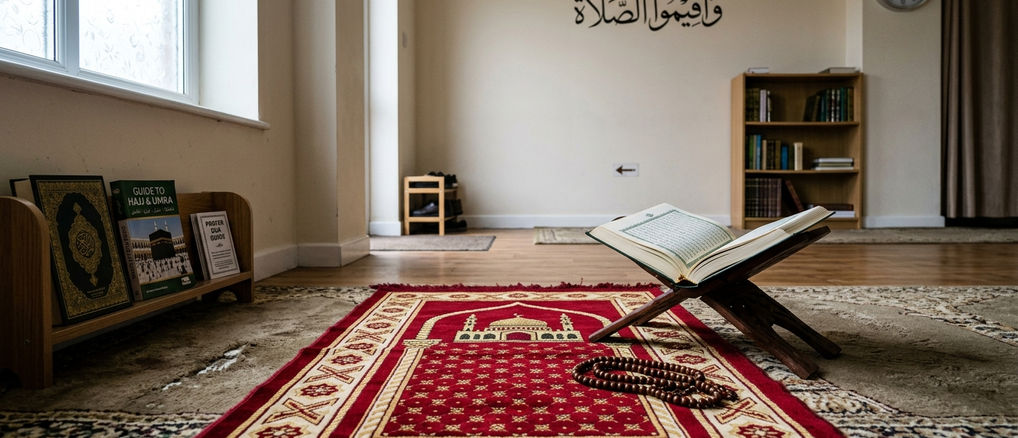
Consider a standard workday. A professional checks the Zuhr entry before a 13:00 meeting and identifies a clean room by 12:45 rather than searching frantically after the meeting starts. In a school setting, students can use a lunch break, a study period, or a supervised quiet room. An around 5 to 8 minute prayer can be performed discreetly without turning it into a public argument.
Commuting requires similar foresight. A traveler boards at 16:20, knowing Maghrib will enter before arrival. They plan whether to pray before departure, during a brief stop, or immediately upon arrival if time remains.
Field Note: Prepare before the prayer time enters: know the qiblah, carry a small prayer mat if useful, and identify a clean location before meetings begin.
Travel prayer, combining discussions, and Jumu‘ah alternatives carry specific conditions. These should be checked with a qualified Hanafi scholar because rulings may depend on specific geographic constraints when the journey distance, timing, or local congregation situation is unclear.
Food, Family Routines, and Preserving Islamic Identity
Preserving Islamic identity extends beyond ingredient inspection. It shapes household formation. Family routines build the foundation. Parents pack school lunches the night before. They check ingredients before birthday parties. They manage expectations by telling hosts close to 3 to 5 days ahead that the family eats halal.
Invitations offer a chance for neighborliness. A Muslim can attend a gathering for kinship while politely avoiding pork, alcohol, or doubtful meat. This requires tact. The host should never feel attacked.
Children absorb these habits early. Parents explain halal at an age-appropriate level before the first school trip. They prepare Eid clothes before the last week of Ramadan. When a party centers on a prohibited practice, they arrange an alternative activity. A guaranteed halal alternative at a birthday party prevents feelings of deprivation. Multilingual guidance proves especially useful here. A child might study in English while grandparents speak Urdu, Arabic, Bengali, or another home language, and the mosque lesson uses entirely different terminology.
Planning prevents isolation. We avoid two extremes: dissolving Islamic boundaries to fit in, and making ordinary social interaction seem religiously impossible.
Work, Citizenship, and Public Conduct Without Losing Adab
Employment and public conduct require separating lawful cooperation from prohibited participation. A workplace is not condemned by its label alone. The focus remains on what the employee actually does.
A sound workplace arrangement allows an employee to process payroll accurately while refusing to falsify time sheets. They might request a modest uniform adjustment. If a role involves serving alcohol, they ask to be moved away from direct service where reassignment is permitted. Contracts demand scrutiny. A receptionist, an accountant, a delivery worker, and a sales agent face different legal questions even inside the same broad industry. The ruling depends on what is signed, represented, sold, witnessed, or approved.
Civic duties align with Islamic ethics. Obeying traffic law, maintaining neighbor rights, reporting hazards, and participating in lawful community welfare are expected behaviors. A Muslim cooperates in civic good without endorsing religiously prohibited conduct.
Public adab requires observable professionalism. Arriving on time after a prayer break builds trust. Documenting requests politely prevents misunderstandings. Avoiding ridicule of non-Muslim colleagues maintains dignity. Declining impermissible invitations without theatrical judgment reflects true character.
When a Personal Fatwa Is Necessary
General educational guidance orients the reader. It does not replace specific legal judgment. Questions involving rights, contracts, divorce, inheritance, medical risk, and mixed-faith family disputes require a certified scholar.
Prepare the exact wording of a mortgage, employment clause, divorce statement, medical consent form, or inheritance document before making contact. Scholars need operational facts. They need the country or state, dates of signing or verbal statements, available alternatives, and current financial pressure. They must know whether money has already changed hands and whether another person’s rights are affected.
A realistic inquiry packet makes the process clearer. Provide a one-page summary, copies of relevant clauses, a timeline of events in date order, and a clear question. Avoid long emotional narratives with missing facts.
Important: Do not ask several sources the same question while withholding inconvenient details until one answer feels easier.
A Worked Example: The Friday Shift
Consider an English-speaking Hanafi Muslim working a hospital support shift from 10:00 to 18:30 on a Friday. The normal meal break is assigned at 14:15. The local Jumu‘ah khutbah begins at 13:10.
The method dictates action early in the week. The worker checks the Jumu‘ah window. They identify a nearby mosque or a designated hospital prayer room. By Wednesday afternoon, they ask the supervisor for a shifted break from 12:55 to 13:45. They offer to swap a later task or cover another staff member’s short break to ensure ward coverage.
If the employer refuses, the worker documents the request respectfully by message or email. They do not abandon the shift without due process. Instead, they consult a qualified scholar, providing the schedule, the refusal reason, the distance to the congregation, and available alternatives.
When the request is approved, the preparation pays off. After arranging coverage, the worker leaves the ward desk at 12:55. They walk down the quiet corridor, reaching the small prayer room just before the khutbah begins. They pray shoulder-to-shoulder with a handful of staff and visitors, fold their hospital jacket over a chair, and return to the floor before the next round of duties.