Ihram Begins with Ritual Entry, Not a Change of Clothes
A pilgrim can wear ihram garments for hours before entering the sacred state. Putting on the two unstitched white cloths in a home or airport washroom belongs to physical preparation; legally effective entry into the sacred state occurs only when the formal conditions of ritual consecration are fulfilled.
In Islamic jurisprudence, ihram designates a distinct legal state carrying specific devotional obligations and behavioral restrictions. The two cloths commonly worn by male pilgrims serve as the attire required during this state, whereas the state itself governs both men and women regardless of the specific fabric on their bodies. Therefore, assessing pilgrimage conduct begins with establishing whether formal ritual entry has taken place before examining what the pilgrim is wearing or doing.
The rulings below follow Sunni Hanafi jurisprudence, moving from boundary preparation and daily conduct through to infringement assessment and final release. Under Hanafi principles, legally effective entry into ihram requires the inward intention (niyyah) combined with the verbal recitation of the talbiyah or a legally recognised equivalent. Merely dressing for pilgrimage does not initiate the sacred state.
Differences among the Sunni legal schools make precision at the point of entry important for travellers. The Shafi‘i school, for example, treats the inward intention alone as sufficient to establish ihram without requiring the accompanying verbal talbiyah as a strict condition of validity. Because the Hanafi entry formula is not unanimous across all schools, pilgrims following a specific curriculum or travelling in mixed-school groups must remain clear on which legal threshold governs their actions.
Prepare and Enter Ihram Before Crossing the Pilgrimage Boundary
Entering the sacred state requires coordinating physical travel with geographical boundaries established by Prophet Muhammad (PBUH). Rather than treating the arrival in Makkah as the starting point, a pilgrim must prepare and enter ihram before crossing the designated boundary.
- Establish the relevant pilgrimage boundary: Identify the specific miqat that governs your geographical starting location and travel route.
- Prepare clothing and personal hygiene: Attend to washing, grooming, and changing into permitted attire while still outside the boundary.
- Identify the intended pilgrimage: Determine clearly whether the ritual entry is for Umrah alone or for a specific form of Hajj (ifrad, qiran, or tamattu‘).
- Enter ihram before crossing the boundary: Formulate the firm intention in the heart and utter the talbiyah aloud before passing the miqat threshold.
The miqat is the prescribed pilgrimage-entry boundary beyond which a traveller intending Hajj or Umrah may not pass without being in the state of ihram. Which boundary rule applies depends entirely on the pilgrim's starting location, chosen route, and specific intention. It is a territorial perimeter set well outside the sanctuary of Makkah, meaning the legal obligation triggers long before the traveller sees the city.
Distinguishing recommended preparation from strict legal conditions prevents confusion during transit. Performing a ritual bath (ghusl) before entering ihram is an emphasised sunnah when facilities and time allow, yet ritual bathing is not a prerequisite for the state of ihram to begin. Similarly, menstruation does not prevent a woman from entering ihram. A menstruating pilgrim bathes if convenient for cleanliness, enters the sacred state at the boundary alongside other travellers, and simply observes the separate rules governing when she may enter the mosque to perform tawaf.
Choose Permitted Clothing for Men and Women
Once the intention and talbiyah establish the sacred state, clothing rules diverge sharply between men and women. A widespread misconception suggests that ihram prohibits any item touched by a sewing needle. In reality, Hanafi jurisprudence evaluates garments by their legal category—specifically whether an item is tailored or shaped to fit the body or limbs, rather than by the mere presence of thread.

Body Covering
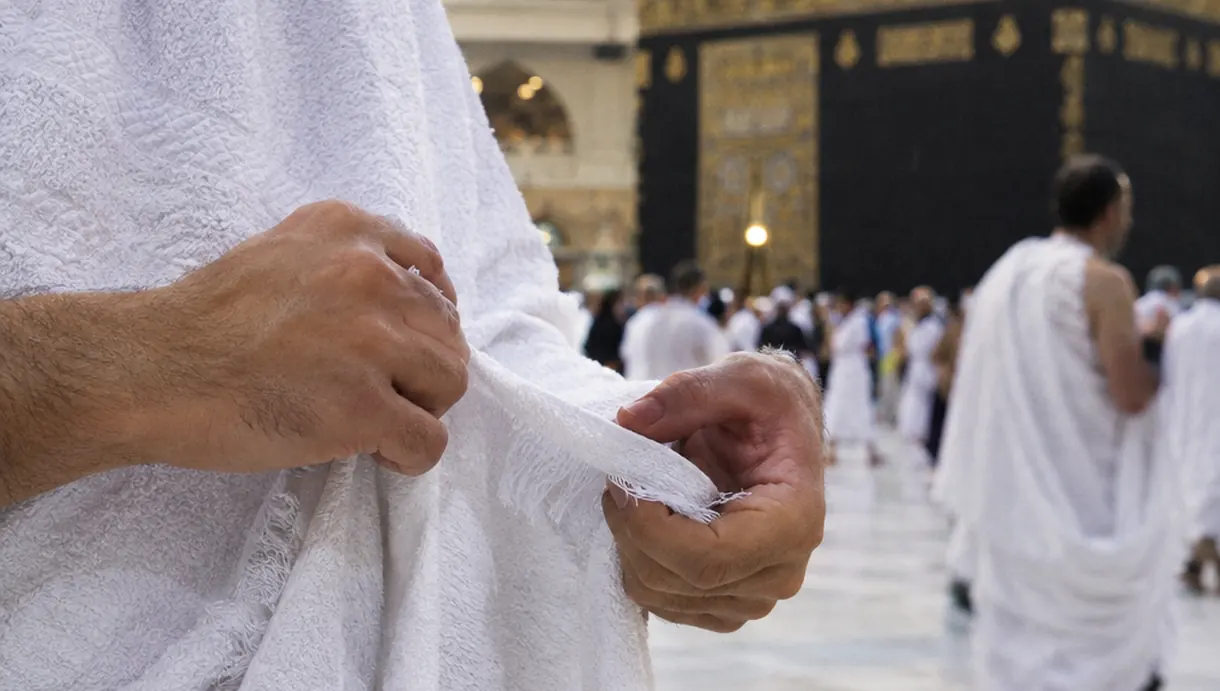
Men wear an unsewn waist wrap (izar) and an upper cloth (rida). A hemmed wrap or a cloth with a repaired tear is not prohibited merely because it contains stitching. The Hanafi restriction prohibits men from wearing garments tailored to encase the body or limbs, such as shirts, trousers, undergarments, and cloaks with sleeves. Women, by contrast, wear their ordinary modest clothing; they are not required to wear white garments, and tailored seams do not affect their ihram.
Footwear
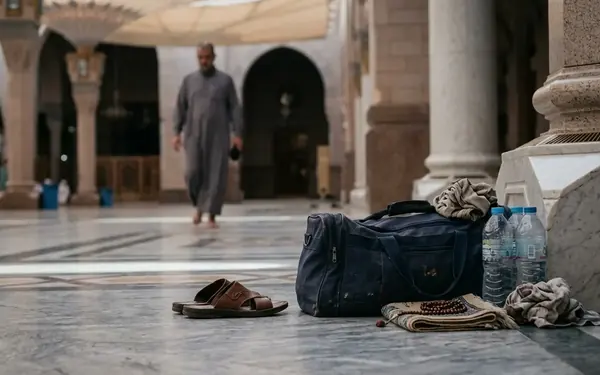
Men must select footwear that leaves the central upper bone of the foot uncovered. Sandals or flip-flops that contain stitched straps are permissible provided this anatomical bone remains exposed. Women are not governed by the men's uncovered-foot requirements and may wear closed shoes and socks throughout their pilgrimage.
Head, Face, and Hand Covering
During ihram, men must keep both the head and face uncovered. Women must cover their heads as part of standard modest dress, but under Hanafi guidance they avoid letting a fabric rest directly against the skin of the face. When screening the face from unrelated men, women arrange a cap or peaked visor so the cloth hangs clear of the facial skin. Hand coverings also require school-specific attention: Hanafi guidance permits women to wear gloves during ihram, whereas other Sunni schools prohibit them.

Securing and Replacing Garments
A man may wear a money belt or securing strap over his waist wrap to hold the cloth in place and carry documents. Furthermore, the physical cloths are not themselves consecrated; replacing a soiled or sweaty wrap with a clean set of cloths does not interrupt the sacred state or require a fresh entry into ihram.
Observe the Restrictions Throughout the State of Ihram
Maintaining ihram Properly requires understanding which everyday actions become restricted upon reciting the talbiyah. However, not every unwanted occurrence carries the same weight. In Hanafi assessments of a potential infringement, factors such as duration, extent, medical necessity, and whether an act was deliberate or forgotten directly affect the legal outcome. Unlike some other schools of thought, Hanafi law does not treat forgetfulness as automatically cancelling the need for compensation across all categories of infringement.
Grooming and Fragrance
After entering ihram, both men and women must refrain from deliberate hair removal, nail trimming, and the application of perfume or fragranced substances to the body or clothing. Precision is necessary when evaluating daily occurrences. A single hair noticed on a towel or pillow does not, by itself, establish that unlawful grooming took place; deliberate plucking, vigorous rubbing, and the total amount of hair removed require separate factual assessment.
Clothing and Covering
The garment and covering rules outlined in the previous section remain continuously in force until formal release. Men must remain vigilant regarding head and face coverings not only while walking between rites, but also while resting or sleeping in hotel rooms and transit lounges, ensuring blankets or pillows do not drape over the head or face.
Intimate Conduct
Marital intercourse and associated intimate conduct such as kissing or touching with desire are strictly prohibited during ihram. These actions require the highest level of caution because the legal consequences are severe and depend heavily on the exact act committed and the specific stage reached within the sequence of Hajj or Umrah.
Hunting and General Conduct
The prohibition concerning hunting land game (and assisting others in hunting it) is explicitly anchored in Qur'an 5:95. Scholars caution that this specific scriptural verse governs terrestrial hunting and should not be cited as a catch-all proof for unrelated clothing or grooming rules. Finally, pilgrims must refrain from quarrelling, foul language, and harming others. While these moral prohibitions are obligatory outside ihram as well, their violation during pilgrimage compromises the spiritual integrity of the journey.
Bathing, Resting, and Changing Garments During Ihram
First-time pilgrims frequently worry that routine physical maintenance will accidentally terminate their sacred state. Separating the question of whether an activity ends ihram from whether an incidental action breaches a restriction clarifies daily conduct.
May a pilgrim bathe or shower? Yes. Washing the body with water does not end ihram. The legal points to watch during a shower are avoiding fragranced soaps and avoiding vigorous scrubbing that pulls out hair.
May a man use an umbrella or sit under shade? Yes. Seeking overhead shade from the sun—whether beneath a building roof, a tent, a car roof, or a handheld umbrella, is entirely permissible as long as the shading object does not rest directly on the head or face.
May a pilgrim change wraps or temporarily remove the upper cloth? Yes. Changing into fresh ihram cloths or adjusting the upper garment to wash or rest does not release a pilgrim from the sacred state, provided ordinary standards of modesty are maintained in the presence of others.
Does sleeping, using the toilet, or losing wudu end ihram? No. The state of ihram remains intact through sleep and breaks in ritual purity. The requirement to hold valid wudu applies separately to specific rites such as performing tawaf.
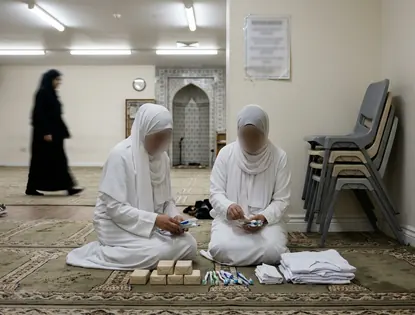
Must women suspend ordinary hygiene? No. Women maintain their normal washing routines and change into clean clothing whenever needed throughout the pilgrimage.
Pre-Departure Toiletry Inspection
Examine lotions, soaps, and wet wipes before leaving home rather than relying blindly on an "unscented" marketing label. Commercial labels often mask baseline aromatic compounds; checking the actual ingredients and how a product is used allows you to verify compliance before entering the sacred state.
Assess a Possible Violation Before Choosing a Remedy
When a pilgrim suspects a rule has been broken, panic often leads to hasty, incorrect payments. If an avoidable infringement is underway—such as a man realising he has pulled a blanket over his head—the immediate step is to stop the act at once. For medically necessary interventions, however, a pilgrim should obtain the needed medical care without delay and subsequently report the exact nature of the treatment to a scholar, rather than postponing urgent care out of fear of a penalty.
Compensation in pilgrimage law is not a single universal flat fee. Depending on the specific act and its surrounding circumstances, a verified ruling may require a minor charity donation, a sequence of fasts, or a sacrificial animal; conversely, potentially invalidating acts require an entirely different level of legal assessment. Recording the exact duration and context of an infringement is essential before determining whether compensation applies.
Understanding basic legal terminology helps pilgrims communicate accurately with scholars:
- Fidyah: A general term meaning compensation or ransom, often referring to the three-option concession (fasting, feeding the poor, or sacrifice) mentioned in Qur'an 2:196 for a pilgrim forced to shave early due to illness or a head ailment. Note that Qur'an 2:196 addresses this specific medical concession and is not a complete compensation schedule for every type of ihram infringement.
- Dam: Literally "blood," denoting a sacrificial animal (such as a sheep or goat) slaughtered within the sacred precinct to make amends for a specific infringement or the omission of an obligatory rite. A compensatory dam must be strictly distinguished from the thanksgiving offering (dam al-shukr) naturally associated with performing Hajj al-tamattu‘ or Hajj al-qiran.
If marital intercourse or another potentially invalidating act occurs, the pilgrim must seek urgent consultation with a qualified scholar rather than attempting to select a remedy from a simplified penalty chart. Before contacting a scholar for any suspected infringement, gather the following factual details while they remain fresh:
- What happened: Identify the specific act, garment, substance, or body area involved.
- When it happened: State whether the incident occurred before or after formal ritual entry, and note which pilgrimage rites had already been completed.
- How much or how long: Record the approximate duration a prohibited garment was worn, the surface area covered by fragrance, or the number of hairs or nails affected.
- Why it happened: Clarify whether the action resulted from forgetfulness, coercion, medical necessity, or deliberate choice.
Because accurate compensation rulings depend on these exact variables, present these details to a scholar competent in Hanafi pilgrimage law.
Leave Ihram Only After the Required Release Rites
Two cloths, two legal checkpoints: dressing does not establish ihram, and changing back does not establish release. A pilgrim who completes the walking rites and simply puts on a stitched shirt in the hotel room before performing the prescribed hair removal has not exited the sacred state; instead, he has committed a clothing infringement while still bound by ihram.
For Umrah, the obligatory release sequence requires completing the seven circuits of tawaf, performing the seven lengths of sa‘i between Safa and Marwah, and then executing the prescribed shaving (halq) or trimming (taqsir) of the head hair. Only upon completion of the haircut do the restrictions of Umrah ihram come to an end.
Hanafi law sets a strict quantitative threshold for hair trimming. Clipping two or three isolated hairs with scissors at the edge of the Marwah exit does not satisfy the requirement of release. To be valid under Hanafi rules, trimming must remove approximately a fingertip's length of hair across at least one quarter of the head; men whose hair is already shorter than a fingertip's length must shave the head or seek a specific assessment rather than performing a token clip. Women release themselves from ihram solely by trimming a fingertip's length from the ends of their hair; shaving the head is forbidden for women.
During Hajj, exiting ihram occurs in two distinct stages: initial release and complete release. In the Hanafi sequence on the tenth of Dhul Hijjah, once a pilgrim completes the stoning of the large pillar and performs the prescribed shaving or trimming, initial release is achieved. At this point, clothing, grooming, and fragrance restrictions end, allowing men to wear ordinary clothes. However, marital intimacy remains strictly prohibited until the requirements for complete release—including the obligatory visitation circumambulation (tawaf al-ziyarah)—have been fulfilled. Pilgrims must never infer permission for marital intimacy merely from the permission to wear ordinary stitched clothing. Furthermore, this outline serves as a structural overview rather than an exhaustive Hajj release schedule: pilgrims performing ifrad, qiran, or tamattu‘ must follow their own verified ritual sequence, accounting for how any delayed or incomplete rite affects their transition between stages.
Write Your Ihram Entry Point into Your Flight Itinerary
To see how preparation and legal entry separate in practice, consider a passenger flying from London or Istanbul directly to Jeddah to perform Umrah. Because King Abdulaziz International Airport in Jeddah lies inside the miqat perimeter for most international flight paths, waiting until the aircraft lands to enter ihram means crossing the boundary without consecration.
A prepared traveller separates the physical dressing point from the legal entry point. Before boarding the aircraft—or at a transit airport with dedicated changing rooms—the male pilgrim washes and puts on his waist wrap and upper cloth. Throughout the boarding process and the early hours of the flight, he is wearing ihram attire, yet he is not in the state of ihram. He may still use scented soap in the airport lounge or adjust a cap if cold, because his ritual entry has not occurred.
The aircraft's miqat crossing—not the Jeddah arrivals hall—is the entry deadline for the passenger already intending Umrah. Because flight routes shift with weather and onboard pilot announcements vary in reliability, travellers should not rely on a generic rule of thumb regarding how many minutes before landing to recite the talbiyah. Instead, consult the airline's route map prior to departure to identify when the flight path approaches the boundary parallel to the coast or mainland.
Before you travel, write on your itinerary where you will make your pilgrimage intention and recite the invocation before crossing the boundary.